
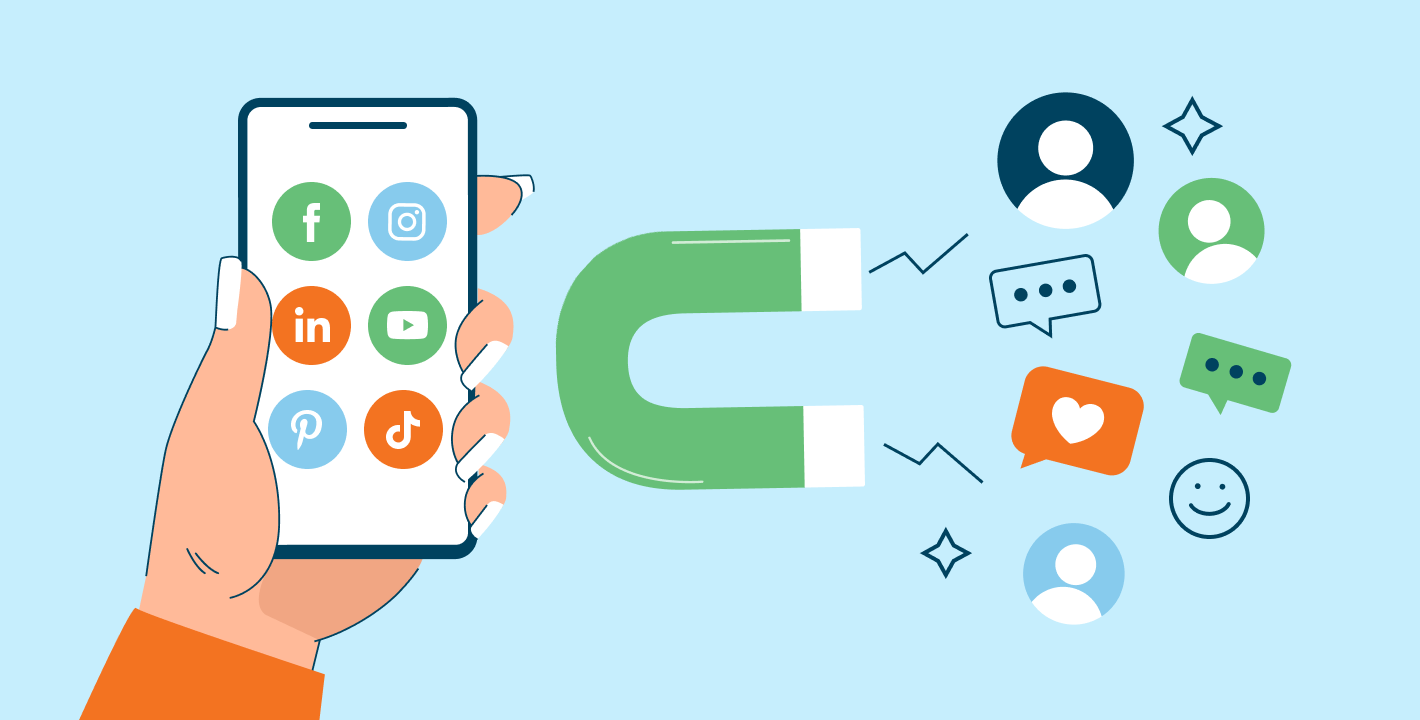
Everything you need to know about inbound marketing
Today, the digital world (the internet, the web and social media) is a fundamental pillar for every company, whatever its size. It offers opportunities with almost infinite potential and makes it possible to reach the desired target up close.
Digital strategies are gaining ground, and entrepreneurs keep seizing this real opportunity to grow their business and revenue, yet they are often poorly exploited, even though the digital world offers much more.
With limited resources, investing in traditional marketing to attract prospects can prove costly. Adopting a digital strategy, on the other hand, is an effective alternative to outbound marketing, making it possible to reach the target directly and more efficiently.
To make the most of marketing efforts, a solution was developed by Brian Halligan, the founder of inbound marketing.
Let’s look together at what inbound marketing is.
- What is inbound marketing?
- The inbound marketing strategy
- Attract (traffic acquisition)
- Convert (leads)
- Close (customers)
- Delight (promoters)
1. What is inbound marketing?
Definition of inbound marketing
Inbound marketing is an American concept that focuses on creating quality content that draws people (customers/prospects) to a company and its products.
The goal of an inbound marketing strategy is to attract web users to the website by tailoring the published content to visitors’ interests, and ultimately to turn them into customers in a non-intrusive way, while letting them take the initiative.
This definition can be summed up in the following concepts:
- Quality content: the company must publish interesting, useful content online for its customers or prospects. This content is meant to provide references or advice, without pushing the sales angle.
- Attracting people naturally: in inbound marketing, consumers are drawn to the brand’s products. This also means attracting the right target with the right content, that is, people who are naturally interested in the products or services.
- Increasing traffic, converting contacts, closing sales and satisfying customers over time: the aim of inbound marketing is to attract more potential customers to visit the website, blog or social media.
However, this flow should not be judged on numbers alone; what matters most is the quality of the prospects.
Inbound marketing can be defined by answering the following question: how do you attract visitors and turn them into customers through simple, non-intrusive, interesting or even entertaining content?
2. The inbound marketing strategy
First, we need to understand the inbound marketing methodology, which consists of four distinct stages.

Attract (traffic acquisition)
To start a sound inbound marketing approach, companies must first attract traffic to their website.
This is a crucial phase that leads to the others: visitors will be won over by good, well-targeted and useful content that meets their expectations, bringing in quality traffic that matches the buyer persona. That is why you need to nurture the traffic sources, which are:

Convert (leads)
Once visitors have been attracted to the company’s website, they must be converted into leads by collecting their personal data, such as email address, phone number, job title or name.
This step leads to the crucial phase, which is the sale, so you need to win them over with lead magnets:
- White papers
- Webinars
- Reports
- Training
By downloading documents from the website, or by signing up for a newsletter.
This information will help personalize the messages sent, according to the topic or a specific need.

The diagram shows the steps for converting visitors into leads.
- Call to action
This is the first stage of visitor engagement: they click an active button and, in return, receive an offer (for example, download a white paper, learn more).
2. Landing page
This is the page leads are redirected to after clicking the call to action. It contains the offer the user wants to obtain in exchange for filling in a contact form.
3. Form
The prospect fills in this form to access the promised offer. It is the most relevant way to collect information about leads.
4. Contacts
Once the leads’ information has been collected, it should be stored in a marketing database so it can be used to interact with them.
Close (customers)
At this stage, visitors have been converted into leads. Now it is time for sales action, that is, turning these leads into customers. Since the company has their contact details, it can start targeted communication. However, as buying behaviors and intentions vary from one prospect to another, they need to be activated differently using mechanisms such as:
- Marketing automation
- Lead nurturing
- Email marketing
- Lead scoring
These mechanisms help the company pick the right leads, those likely to close at the right time.
Delight (promoters)
Building customer loyalty through new technologies:
- CRM
- Social media
- Surveys
- After-sales service
This component, often overlooked, is nevertheless essential to a successful inbound marketing strategy. It does not stop when the customer buys the product; it aims to bring the customer into the sales strategy by turning them into a brand ambassador through a lasting loyalty relationship.
Retaining a customer is never easy. Always uncertain and demanding, customers are constantly solicited by competing offers. Yet retaining them remains far easier than winning new ones.
It is now estimated that acquiring a customer costs five times more than retaining one. That is why retention must be handled with the same rigor as acquisition, in particular by creating high-value, personalized content adapted to customers’ new expectations.
Here are a few ways to reward special customers:
- Gifts: end-of-year, birthday.
- Invitations: private events, evenings, forums, sports competitions.
- Discounts: 50% or 30% off products, flexible payment terms.
- Loyalty cards: earning points on purchases, VIP club: exclusive special offers reserved for members.
Inbound marketing does not need to fight for the attention of potential customers (prospects) or spend extravagant sums on paid ads. Its success comes from several factors (attract, convert, close, delight). These four stages are not necessarily linear or fixed; what matters most is to come out of this strategy win-win.
1 Comment
SEO in Morocco: A Practical Guide for SMEs | SG2i
November 13, 2026[…] guides on the questions your customers ask before buying. This is the principle of inbound marketing: attracting customers when they are […]